Contact us

Creating the new standard for artificial lungs.

OptiLung is a 3D-printed, monolithic blood oxygenator engineered with vessel-like channels to minimize clotting and hemolysis.

The OptiLung device is in development. Not cleared or approved by the FDA. Not available for sale.

The OptiLung prototype, with the blood path dyed red and gas path dyed blue to highlight the channels.

ECMO runs per year in the United States
13,000+
Cost to payers per patient-day on ECMO
$40,000
Typical hospital stay for ECMO patients
10+ days

About ECMO

ECMO: life-saving, yet high risk.

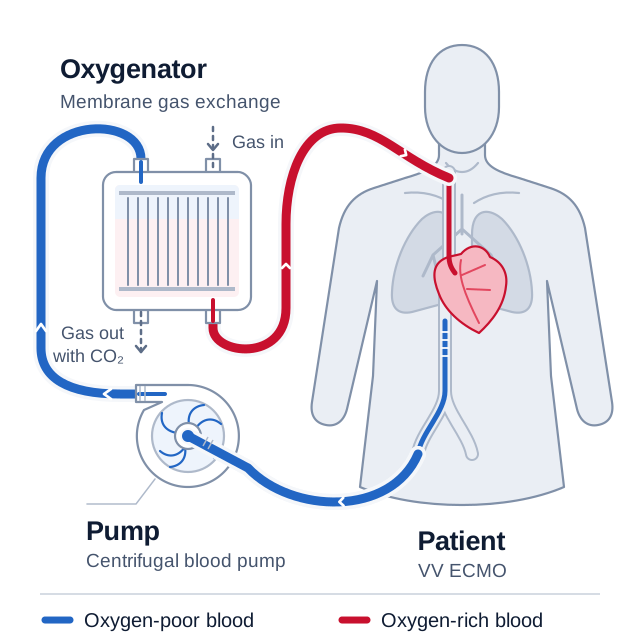
Extracorporeal membrane oxygenation (ECMO) supports the heart and lungs of critically ill patients. Blood is pumped out of the body through an oxygenator that acts as an artificial lung before returning to the patient.

ECMO bridges patients of all ages to recovery or transplant: from neonates with respiratory failure to adults with severe cardiac or pulmonary collapse.

Conventional oxygenator design is a major contributor to ECMO's risks.

01
Large foreign surface
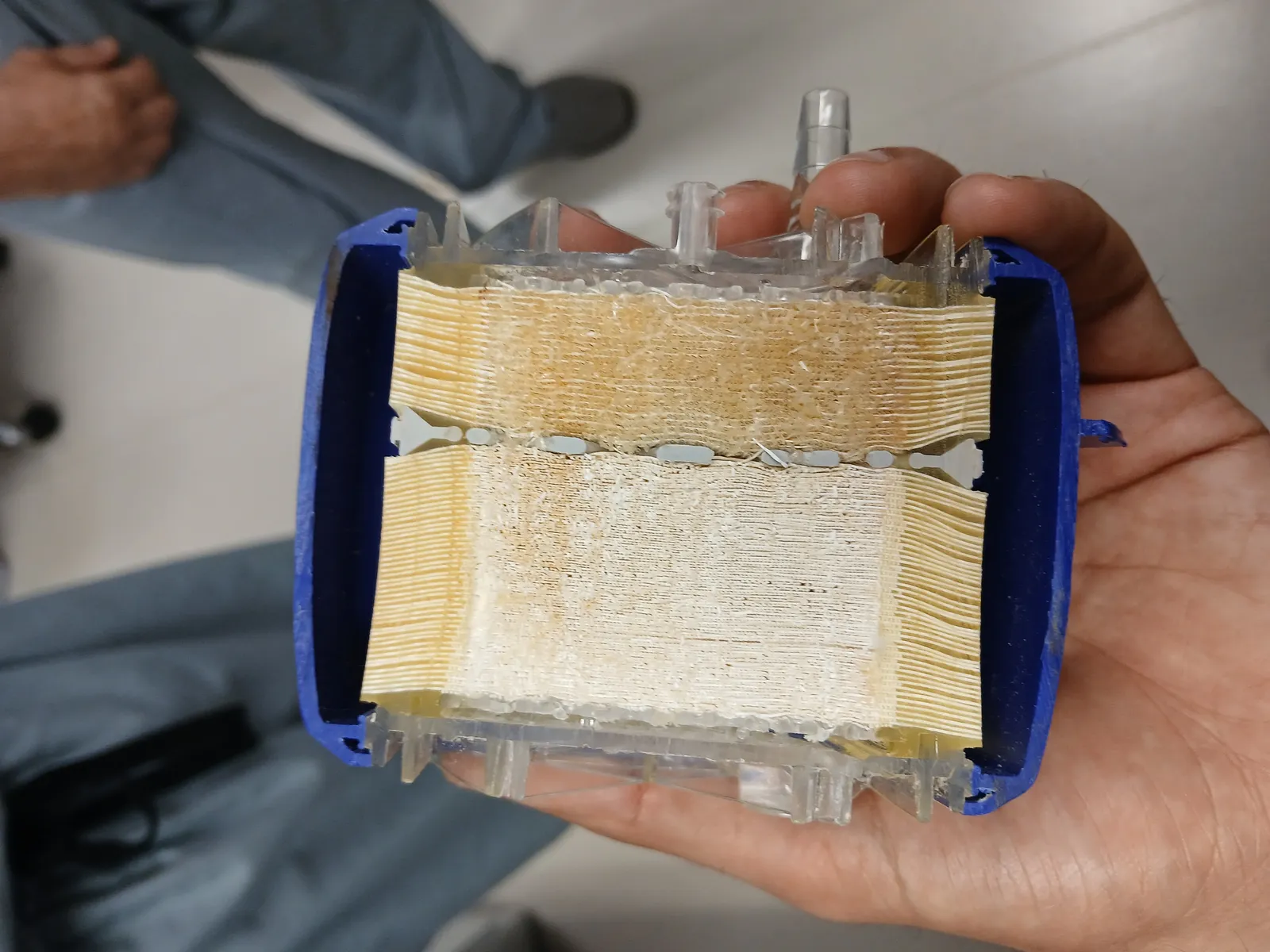
Conventional oxygenators pack bundles of hollow fibers and many plastic components into one housing, exposing blood to a large area of foreign material that can trigger clotting.
02
Non-physiological flow
Flow paths unlike those in the body can damage blood cells and trigger inflammation.
03
Clot-prone, short-lived devices
Clots build up inside the oxygenator and force replacement, and each device change adds risk of embolism and infection.
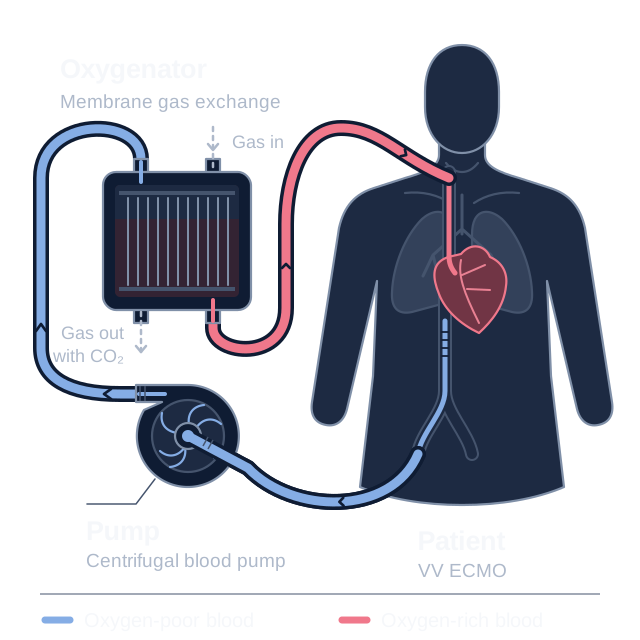
VV ECMO: blood drains through a femoral vein to the central inlet of a centrifugal pump, flows through a membrane oxygenator, and returns through an internal jugular vein. Blue means oxygen-poor blood; red means oxygen-rich blood. The oxygenator has separate gas inlet and exhaust connections.VV ECMO: blood drains through a femoral vein to the central inlet of a centrifugal pump, flows through a membrane oxygenator, and returns through an internal jugular vein. Blue means oxygen-poor blood; red means oxygen-rich blood. The oxygenator has separate gas inlet and exhaust connections.
A venovenous (VV) ECMO circuit. Blood leaves a vein, passes through the pump and oxygenator, and returns to the patient's vein.

There is a clear need for a novel oxygenator architecture that reduces the risk of blood trauma.

OptiLung technology

Blood flows inside the channels, as it does in the body.

Our device is a single 3D-printed part made of a rigid, gas-permeable resin inspired by contact lenses. Additive manufacturing allows lung-inspired channel architectures that conventional hollow-fiber devices cannot replicate.

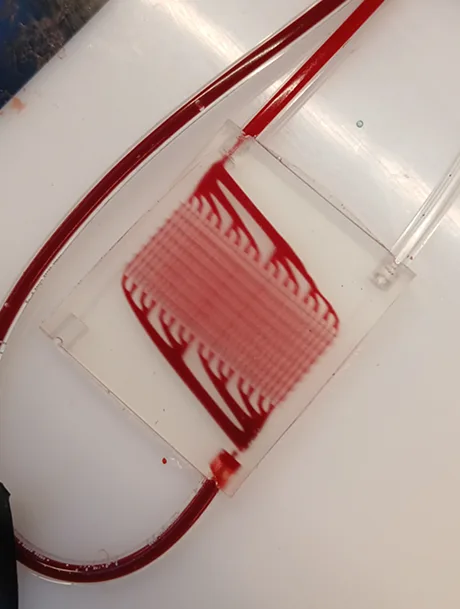
Physical OptiLung prototype connected to tubing, with dark-red blood entering at the bottom left and bright-red blood leaving at the top right.
Dark-red oxygen-poor blood enters through the inlet port (bottom left). Bright-red oxygen-rich blood exits through the outlet port (top right).

OptiLung is designed for

Reduced hemolysis
Blood flows through engineered, vessel-like networks rather than around hollow fibers, enabling precise control over pressure, flow rate, and shear stress.
Reduced clotting
A branching manifold, modeled on vascular networks in lungs and gills, is designed to reduce stagnant flow zones across diverse flow regimes.
Reliable manufacturing
One part. One material. An almost entirely automated process. No manual fiber assembly. No dependence on polymethylpentene (PMP) fiber supply.

How it works

Follow the blood through the oxygenator.

The complete oxygenatorIllustration
  1. Oxygen-poor blood arrives through the inlet and enters the printed blood network.

  2. Red blood cells travel through these channels, with gas channels running alongside.

  3. Oxygen moves from the gas channels through the gas-permeable resin membrane into the blood. Carbon dioxide moves out of the blood into the same channels.

  4. The channels merge into an outlet manifold, and oxygenated blood returns to the patient through the extracorporeal circuit.

Physical prototype · the printed oxygenator with blood path dyed red

Platform

A scalable platform for blood-gas exchange.

Intended applications

  • ECMO
  • Cardiopulmonary bypass
  • Extracorporeal CO₂ removal
  • Artificial placenta

Intended populations

  • Neonatal
  • Pediatric
  • Adult
PrintSped up timelapse of an oxygenator print. No fibers to bundle and seal.

Comparison

Simpler to build. Designed for gentler blood flow.

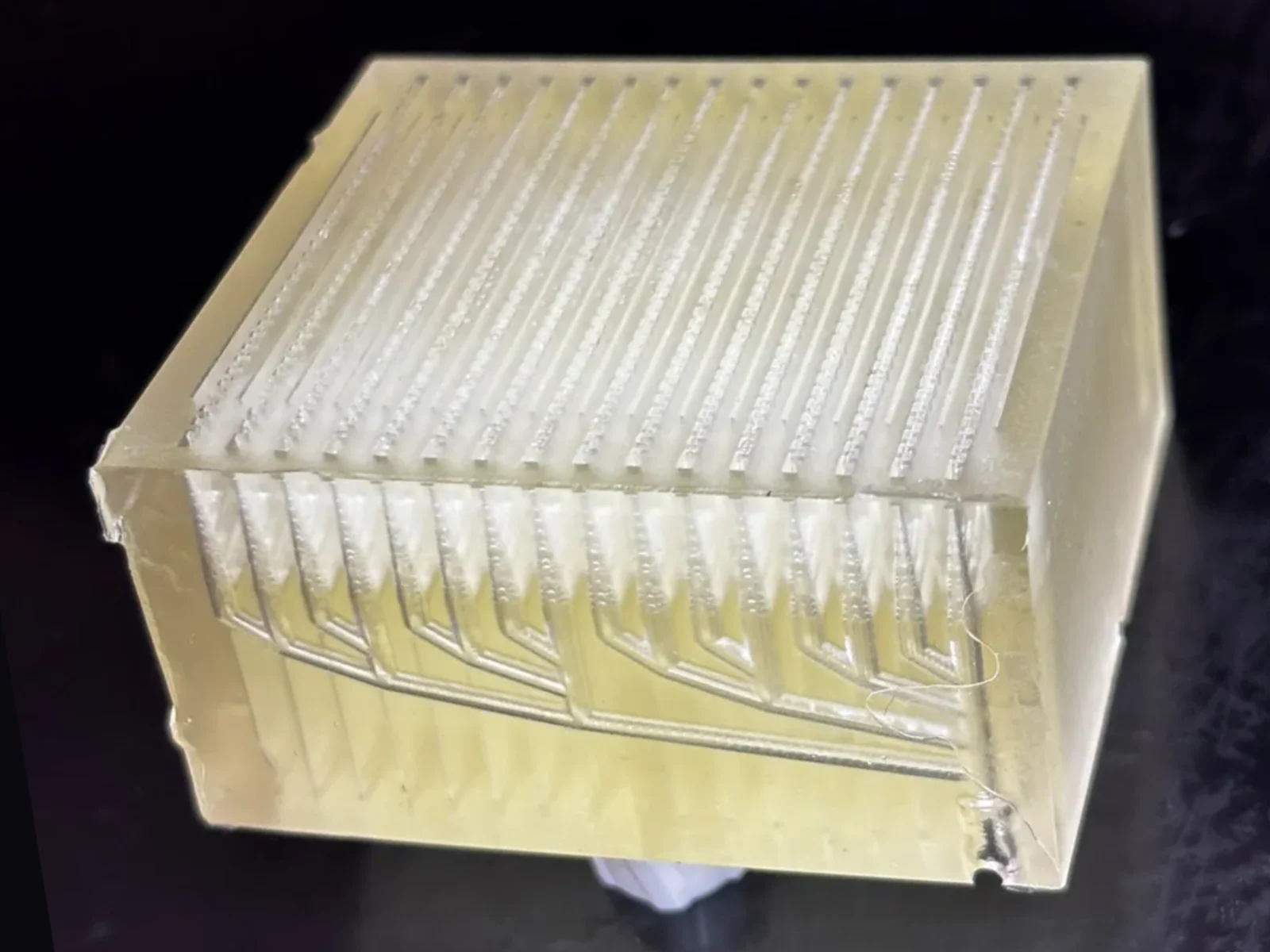
OptiLung prototype: a single clear resin block with rows of blood channels and a branching manifold printed inside.
OptiLung. One 3D-printed part with lung-inspired channels.
A conventional hollow-fiber oxygenator cut open in a hand, showing bundled fibers inside a blue housing.
Typical Oxygenator. Bundled hollow fibers, assembled by hand.
AttributeOptiLungConventional oxygenator
Components17
Materials16
Blood pathInside engineered channelsAround bundled hollow fibers
AssemblyAutomated 3D printingManual fiber potting
Capital equipmentMinimalHigh
Supply chainRobust, onshore resin supplyFragile, offshore fiber supply

Impact

Who stands to benefit?

Patients
Fewer complications, faster recovery, and less time on ECMO and in the ICU.
Clinicians
Less monitoring, and easier management of bleeding and clotting.
Hospitals
Shorter length of stay for ECMO patients, and lower costs for anticoagulation and labs.

Our story

We are a team of physicians and engineers bringing technology out of the lab and into the clinic.

Clinicians, funders, and researchers agree that ECMO needs better technology.

We developed OptiLung to bridge the gap between invention and commercialization. We combine entrepreneurial experience with deep expertise in additive manufacturing of medical devices.
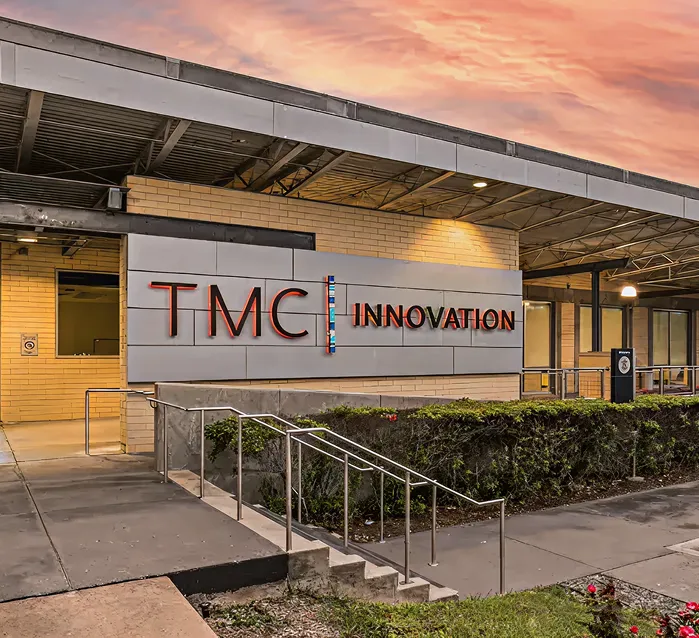
The Texas Medical Center Innovation building in Houston.

Team

  • Matt Gelber, PhD

    Founder & CEO

  • Selene Alikah

    Preclinical Development Lead

  • R. Brandon Hunter, M.D.

    Chief Medical Officer

Affiliated with leading innovation partners

  • Southwest Pediatric Device Consortium

  • Texas Medical Center Innovation Accelerator

Contact

Join us in making ECMO safer than ever.

If you are an investor, engineer, or physician interested in supporting our work, please reach out. If you are an investigator interested in preclinical collaborations, we would love to work with you.

Prefer email? info@opti-lung.com